How to Write a Homepage That Actually Converts
The "I Am a Consultant With 20 Years of Experience" Problem
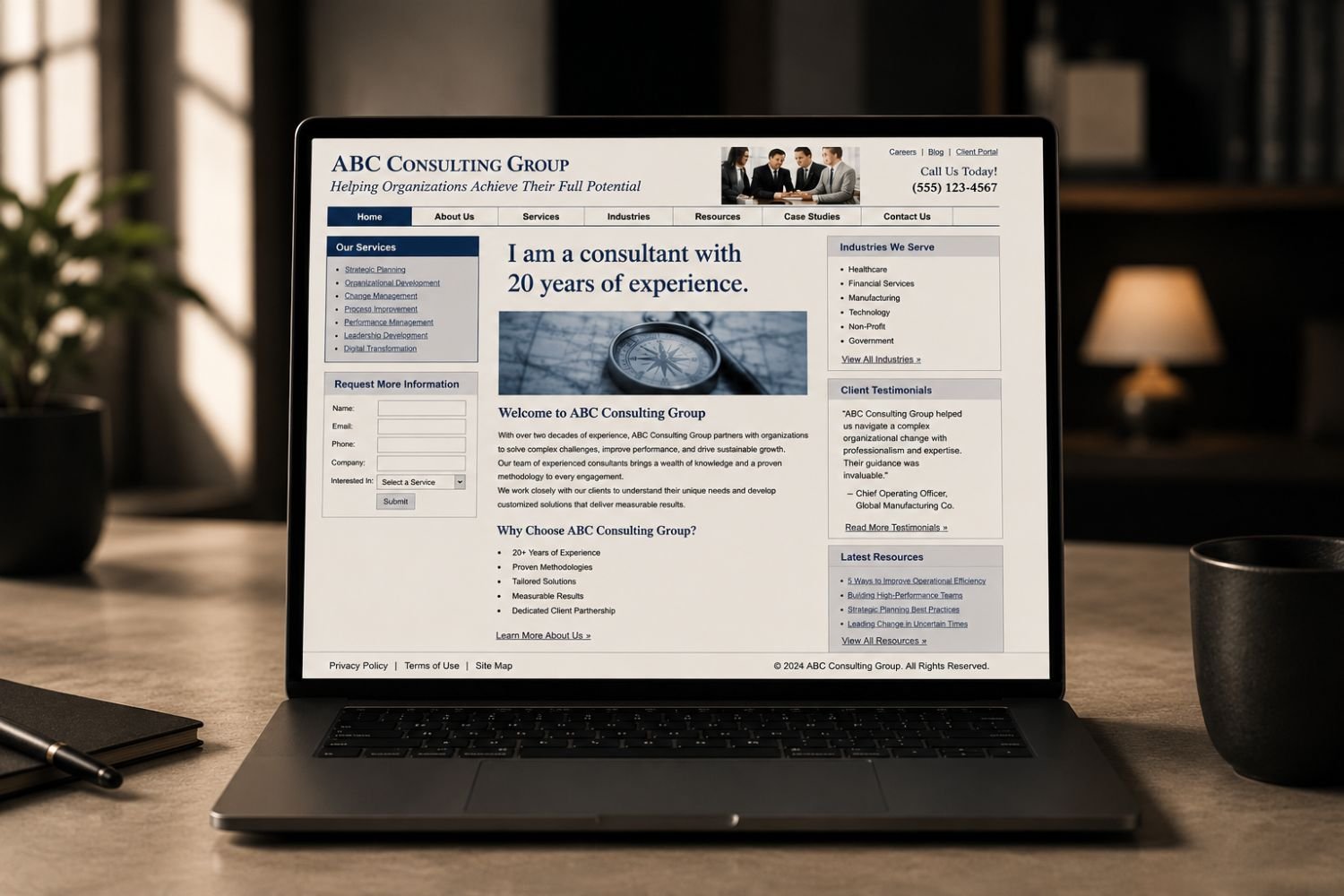
Remember the I/O consultant we talked about in the last post? The one with the PhD, the real expertise, and the website that was quietly losing him clients every single week?
We fixed his positioning problem. His headline now says exactly who he serves and what he solves. Corporate buyers land on his site and immediately know they're in the right place.
But then something interesting happened.
He sent me a draft of his new homepage copy. And the first line read:
"I am an organizational psychologist with over 20 years of experience helping companies achieve their human capital objectives."
The positioning was right. The ICP was right. The structure was right.
The copy was still wrong.
And here's the thing, it wasn't bad writing. It was actually quite polished. It just had a problem that's so common among consultants it might as well be a diagnostic category: it was written from the inside out.
Why Consultants Write Homepage Copy That Doesn't Convert
Here's what happens when most consultants sit down to write their website.
They open a blank page. They think: what do I want people to know about me? And they start writing.
Years of experience. Methodology. Academic background. Professional affiliations. Maybe a mission statement. Probably the word "strategic" at least four times.
It reads like a LinkedIn summary crossed with a CV. Technically accurate. Completely unconvincing.
The problem isn't the content, it's the direction. That copy is written from you outward. Corporate buyers read from their problem inward. They're not starting with "who is this person?" They're starting with "does this person understand what I'm dealing with?"
Those are different questions. And they require completely different copy.
The "20 Years of Experience" Trap
Let's talk about that opening line specifically because it's everywhere.
"I have X years of experience."
"I've worked with hundreds of organizations."
"My approach combines evidence-based methodology with practical application."
None of these statements are lies. They might even be impressive. But they share one fatal flaw: they make you the subject of your own homepage.
Your homepage visitor, let’s say the HR director with a leadership derailment problem, the VP of People staring down a retention crisis is not the supporting character in your story. They are the protagonist of their own story. And right now, their story has a problem they need solved.
Your homepage has roughly eight seconds to signal:
I understand your problem, I've solved it before, and I know how to solve it for you.
"Twenty years of experience" doesn't signal any of that. It signals tenure. Tenure is not the same as relevance.
Here's the test: take your current homepage headline and ask yourself: does this sentence tell my client anything about their situation?
If the answer is no, rewrite it.
What the Consultant's Homepage Actually Needed
When we sat down to rewrite his copy, we didn't start with what he wanted to say. We started with three questions about his client:
What is the HR director dealing with right now, today, before they even found this website?
Not abstractly. Specifically. A leadership team that's underperforming. An assessment process that's inconsistent. A high-potential employee they're about to lose because nobody's developed her. A CEO asking for data on organizational health and no one knows how to produce it.
What words would that HR director use to describe the problem, not what words would the consultant use?
This is the gap that kills most consulting copy. The consultant says "psychometric assessment of high-potential talent." The client says "we keep promoting the wrong people and it's costing us." Both describe the same problem. Only one of them belongs on a homepage.
What does the client want to feel when they finish reading the homepage?
Not impressed. Not educated. Understood. The moment a corporate buyer reads your copy and thinks "this person gets exactly what I'm dealing with", that's the moment they start trusting you. And trust is what books calls.
With those three answers, his homepage rewrote itself. The headline stopped being about him and started being about them. The opening paragraph named their reality before it mentioned his credentials. The credentials showed up but as proof, not as the pitch.
The Homepage Copy Formula That Actually Works for Consultants
Here's the structure we used and the one I recommend for any I/O psychologist or organizational consultant building or rebuilding their homepage copy.
Headline: Name their problem or their desired outcome, not your service.
Weak: "Evidence-Based Organizational Consulting for Growing Companies"
Strong: "Your Leadership Team Is Underperforming. Here's How We Figure Out Why — and Fix It."
The weak version describes what you do. The strong version describes what they're living through and implies you have the answer. That's the difference between a brochure and a conversation.
Opening paragraph: Enter their world before you introduce yours.
Don't open with your background. Open with their situation. Two to three sentences that make the right reader feel immediately recognized like you wrote this specifically for them, because in a sense, you did.
Example: "Most mid-size companies have a leadership problem they can see but can't diagnose. Someone's underperforming, a team's stuck, or a high-potential hire just gave notice — and nobody can quite explain why. That's usually where I come in."
Notice what's not in that paragraph: degrees, years of experience, methodology names. That information comes later. First you earn the right to be heard by demonstrating you understand the problem.
Credibility block: Show proof, not pedigree.
This is where credentials go but framed as outcomes, not credentials. Not "PhD in Industrial-Organizational Psychology from XYZ University."
Instead: "I've helped leadership teams at companies ranging from 80 to 2,000 employees improve retention, selection accuracy, and team performance using the same validated methods used by the top HR consultancies in the world."
Same information. Completely different impact. Pedigree tells them where you've been. Proof tells them what that means for them.
Services preview: Specific deliverables, not category names.
"Organizational Consulting" is a category. A service is: "A 90-day leadership effectiveness assessment with a final debrief report, implementation roadmap, and executive coaching session."
When your client reads a specific deliverable, they can picture it. When they can picture it, they can want it. When they can want it, they book a call.
One CTA. Not five. One.
What is the single most important action you want a homepage visitor to take? Book a discovery call? Download a resource? Read a specific service page?
Pick one. Put it in one place. Make it unmissable.
Every additional option you give a visitor reduces the probability they'll take any option. This is not a theory it's behavioral science. You know this.
Apply it to your own website.
I did it to mine.
What Changed for the Consultant
When we rewrote his homepage with this structure, something shifted almost immediately.
His copy went from explaining I/O psychology to speaking directly to the people who needed it. The HR director landing on his site no longer had to translate his language into her reality his homepage did that for her.
He told me later that two things changed in his discovery calls: they got shorter and they got more serious. Shorter because clients arrived already understanding what he did and already convinced he understood them. More serious because the people who booked were already pre-qualified they'd read the copy, recognized themselves in it, and reached out with a specific problem in mind.
That's what homepage copy is supposed to do. Not impress. Not explain. Convert.
The Rewrite Test You Can Run Right Now
Before we close: here's a quick diagnostic for your current homepage.
Read your headline and your opening paragraph out loud. Then answer honestly:
Is the subject of these sentences you or your client?
Would an HR director who has never heard of I/O psychology understand what you do and who you help?
Does anything in these sentences describe a problem your client is actually living with right now?
If the answer to the first question is "me," and the answer to the second and third is "no" you have the same problem the consultant had. And you can fix it the same way he did.
What's Next
In the next post in this series, we're going to look at what happens after you get your copy right specifically, what your analytics are telling you about where your site is still losing people, and how to read those signals the way a behavioral specialist would.
Because homepage copy is the entry point. But the funnel doesn't end there.
→ If you want to audit your current homepage before then, the I/O Consultant's Website Checklist covers every section we discussed today. Download it free below.
Ángel Comas, PhD is an I/O psychologist and digital strategist. He helps organizational consultants and I/O psychologists build websites that attract corporate clients — not just visitors. Estudio Bohöra offers strategic website templates built specifically for this niche.
→ Explore the Mentora template for organizational consultants.