What Really Supports a Calm Therapy Practice
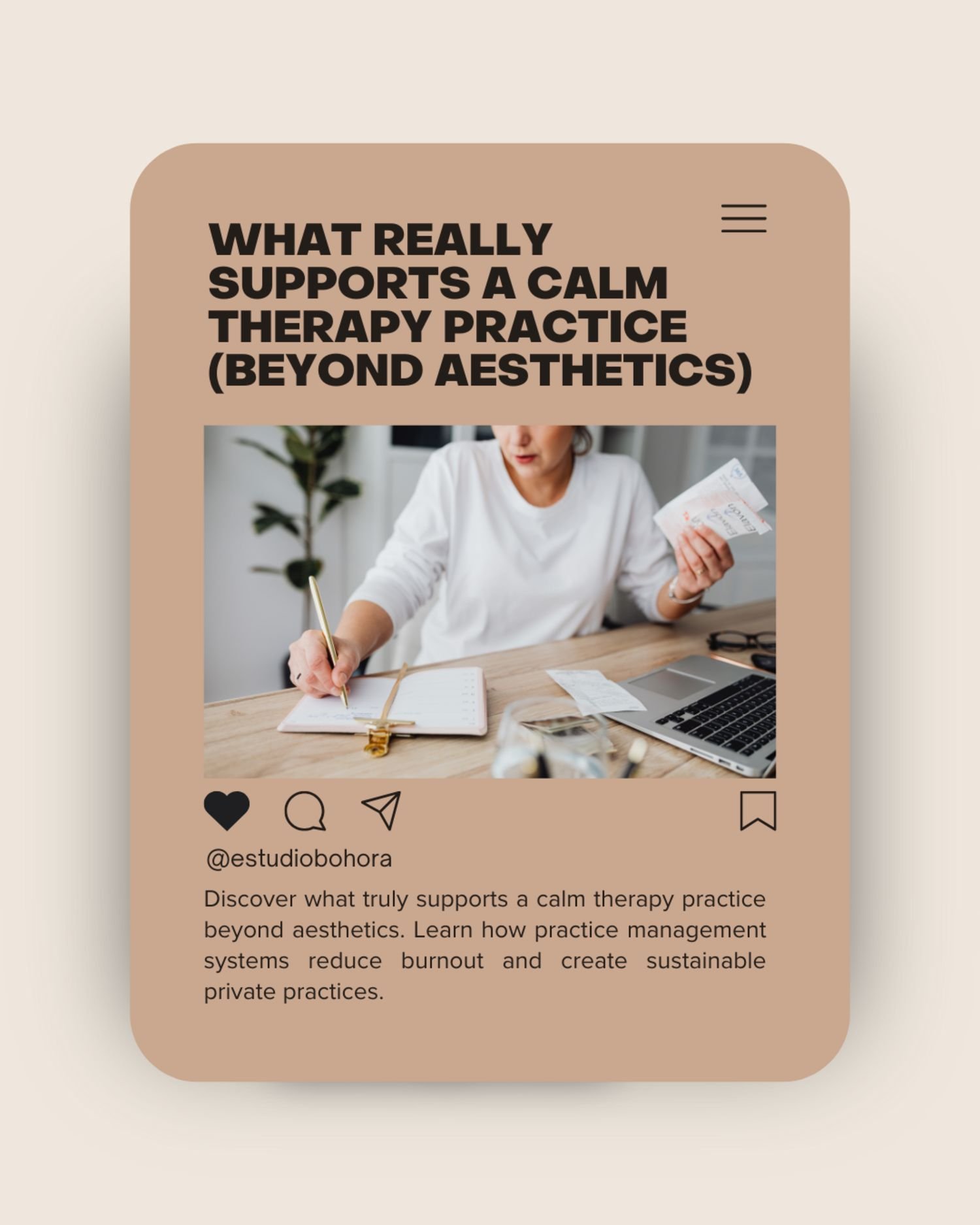
A Calm Therapy Practice Is Built on Systems, Not Just Space
Maybe you've felt it.
That moment at the end of the day when you close your office door, and instead of relief, you feel like the work is just beginning.
Clinical notes waiting. Appointment reminders not yet confirmed. That billing email you've been putting off for days. The mental list of things you "can't forget" tomorrow.
You've invested so much in creating a space that feels safe and grounding. The lighting is warm. The furniture is comfortable. The colors are intentional.
And still—your practice feels heavy.
If this sounds familiar, I want you to know: you're not doing anything wrong.
The calm you're searching for? It doesn't come from another throw pillow or a better Spotify playlist.
Here's what I've learned, both from my own experience and from conversations with therapists who've found their way back to practices that work:
Calm doesn't come from aesthetics alone—it comes from systems.
This same principle applies to how your practice exists online. Calm often begins with building a digital practice without social media, instead of relying on constant visibility to hold everything together.
This post contains an affiliate link to SimplePractice. If you choose to sign up through this link, I may earn a small commission at no additional cost to you. I only recommend tools I genuinely trust and that support ethical, well-structured clinical practices.
Why the Weight You're Carrying Isn't About Your Clinical Skills
Let me guess: the most exhausting part of your private practice isn't actually the therapy work.
It's everything surrounding it.
The last-minute schedule changes. The intake forms you're still customizing manually. The consent documents scattered across different folders. Clinical notes that pile up when you're too tired to write them. Billing questions that pull you out of your clinical headspace. Insurance workflows that make you question why you went into private practice in the first place.
When I talk to therapists about what drains them most, they rarely say "my clients."
They say: "I can't keep track of everything."
And here's what makes this so hard—when your tasks live across emails, calendars, PDFs, and memory, your mind never fully rests.
Even outside of sessions, even on your day off, part of your attention remains stuck on what still needs to be done.
That background noise of undone tasks? That's not a personal failing. That's a design problem.
A well-designed practice management system for therapists doesn't exist to make you more productive. It exists to hold the complexity so you don't have to.
And when complexity has a proper container, calm can finally show up.
The Visible Layer: Yes, Your Physical Space Still Matters
Let's be clear: the physical environment still matters. Deeply.
A thoughtfully designed therapy space can:
Help regulate the nervous system
Communicate safety and professionalism
Create clear boundaries
Prepare clients for the work ahead
This is why you spent time (and probably money) refining your office. The space sets the tone. It matters.
But here's the part that often goes unspoken:
The physical space only supports what happens during the session.
It doesn't manage what happens before the first appointment. It doesn't track how information is collected and stored. It doesn't protect your time between sessions. It doesn't determine how your practice runs day to day.
That responsibility falls to something less visible—but way more powerful.
The Invisible Layer: How Your Practice Actually Runs (And Why It Matters More Than You Think)
Every therapy practice has an operating system, whether you built it on purpose or not. The same is true online. Whether intentional or not, every practice operates within a digital system. Designing a digital-first ecosystem allows that system to support your work instead of constantly demanding attention.
Some practices run on:
Memory
Handwritten notes
Five different tools that don't talk to each other
Constant improvisation
Daily problem-solving
Others run on structure.
And here's what I've noticed over and over: the difference between a practice that feels calm and one that feels draining has very little to do with clinical skill—and everything to do with how the work is supported behind the scenes.
This is where practice management stops being just an admin thing and becomes a clinical thing.
When your systems are unclear or all over the place:
Mental load goes up
Boundaries get blurry
Burnout creeps closer
When your systems are clear and in one place:
Attention gets freed up
Decisions go down
The practice gets easier to sustain
Calm isn't the absence of work. Calm is the absence of unnecessary friction.
Before choosing tools or templates, clarity comes first.
Many therapists try to solve overwhelm by adding platforms or redesigning aesthetics—without ever clarifying how their homepage is meant to work.
If you want your website to support calm instead of adding friction, this simple homepage checklist helps you pause, organize, and design with intention—before making any decisions.
The Tools That Actually Help (Versus the Ones That Add More Noise)
Not all tools support calm.
Many platforms promise growth, visibility, or scale—but quietly add more complexity, more dashboards, more decisions, more tabs open in your browser.
In contrast, the tools that genuinely support therapists tend to share a few key qualities:
They bring things together instead of spreading them out
They reduce manual steps
They create predictable routines
They mostly disappear once they're set up
This is why many therapists I know have quietly shifted to practice management software like SimplePractice.
Not because it markets itself the loudest. But because it represents something different: bringing everything into one place so you stop losing mental energy to keeping track.
By combining scheduling, documentation, client intake, consent forms, billing, insurance workflows, and a secure client portal—all in one spot—the system becomes a container. Not another source of mental clutter.
When your administrative work lives in one place:
You get back mental energy you didn't realize you were spending
Your clients experience clarity and professionalism
Your practice becomes genuinely easier to sustain
These benefits rarely show up in Instagram reels or before-and-after photos.
But they show up in how you feel at the end of the week.
Structure Is Professional Self-Care (Even Though No One Talks About It That Way)
We talk about self-care as something outside of work.
Time off. Boundaries. Bubble baths and yoga.
But for therapists? Structure itself is a form of care.
A system that:
Holds information safely
Handles repetitive tasks automatically
Reduces decision fatigue
Protects your time and attention
...isn't just a convenience.
It's what allows your clinical presence to stay intact.
A practice management system doesn't replace the relational work. It protects the conditions that make that work possible.
Your Website Plays a Bigger Role Than You Think
Alongside your internal systems, your website plays a big (and often underestimated) role in reducing friction.
A well-designed website:
Clearly communicates who you help and how
Sets expectations before the first contact
Answers the most common questions
Guides potential clients toward the next step
When your website is unclear or overwhelming, the burden on you increases:
More emails asking basic questions
More time spent explaining your process
More back-and-forth before anything is scheduled
When your website is clear and intentional, it works as an extension of your systems—not another thing you have to manage.
Your website isn't just marketing. It's part of your practice management. When approached intentionally, your website becomes part of a larger system—one that reflects the principles of designing a digital-first practice built for sustainability, not noise.
The Full Picture of a Sustainable Practice
A calm practice isn't built on a single element.
It emerges when multiple layers support each other:
Physical space – Supports emotional regulation and trust during sessions
Digital presence (your website) – Provides clarity before the first interaction
Operating systems – Support scheduling, documentation, and communication without constant friction
Clear boundaries – Protect both you and your clients from overextension
When one layer is weak, the others compensate—for a while. Over time, the imbalance shows.
Sustainability isn't about perfection. It's about alignment.
Calm Isn't Minimalism—It's Intentionality
A calm practice isn't necessarily minimal.
It might be full, busy, and very active. But it's intentional.
Intentional systems allow:
Fewer last-minute decisions
Fewer interruptions
Fewer unresolved tasks hanging in the background
This is why supporting sustainable therapy practices requires more than aesthetics or motivation.
It requires design—not just of your space, but of your systems.
You Don't Need to Do More—You Need Better Support
The online world constantly encourages therapists to:
Offer more services
Expand to more platforms
Grow faster
Post more content
But here's what I believe many practices actually need:
Not more output. Better support.
A practice that relies on constant effort and improvisation will eventually demand more than it gives back.
A practice supported by thoughtful systems allows:
Steadier energy
Clearer boundaries
Deeper presence with clients
That's not a productivity hack. That's ethical practice. For many therapists, this shift begins by rethinking how their practice exists online. Understanding how a digital-first practice supports calm often creates the clarity needed before choosing any specific tools.
Final Thought
If you've refined your office, updated your website, clarified your offerings—and something still feels off—you might not need more strategies.
You might need better structure.
A calm therapy practice isn't defined by how it looks. It's defined by how well it holds the work.
A calm practice doesn't look perfect from the outside. It feels sustainable from the inside.
And if what you just read resonated with you—if you felt that small moment of recognition or relief—know this:
You don't have to figure all of this out alone.
There are tools designed to support exactly this kind of practice. SimplePractice is one of them—not because it's the flashiest option, but because it's built around this exact principle: hold the complexity so the therapist doesn't have to.
Explore SimplePractice and see how centralized practice management can support the kind of practice you want to sustain.